
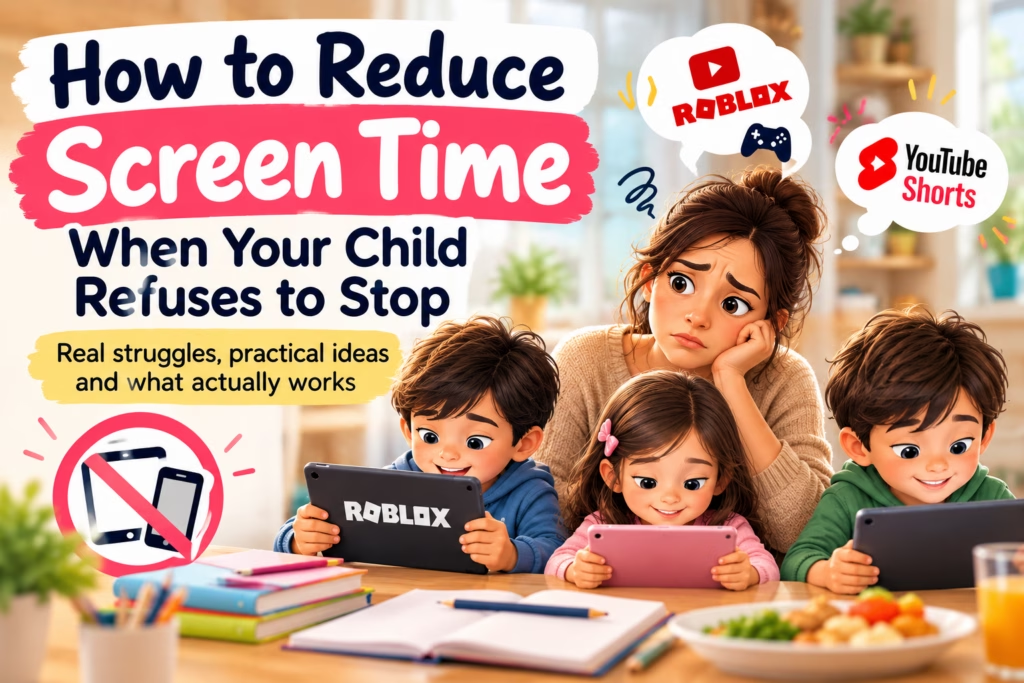
If you search for how to reduce screen time when your child refuses to stop, you’ve probably already seen the usual advice: set a screen-time limit, make a routine, use a reward chart, offer other activities, talk calmly to your child and, above all, be consistent.
I know this advice because I have tried almost all of it. And right now, it isn’t working in my house.
My children have reached a stage where Roblox, YouTube Shorts and videos of other people playing Roblox seem more interesting than almost anything I can offer them. As a mother, I’m exhausted.
This isn’t another article from a parent who has completely solved the screen-time problem. I’m still dealing with it. I want to share what is actually happening in our home, what hasn’t worked for us and what I’m now trying differently.
It Wasn’t Always Like This
What bothers me most is that screens weren’t always this way in our home. My children used to watch things I was actually quite happy for them to watch, educational videos, number sequences, Nat Geo and shows such as Omar & Hana.
I wasn’t against screens then, and I’m not trying to raise children who never touch a tablet now. The problem is that their relationship with the tablet seems to have changed.
Given the choice, they now mostly want Roblox, videos of other people playing Roblox with commentary, or YouTube Shorts.
And Roblox isn’t simply one game they finish and put down. There are endless experiences and mini-games inside it. One thing leads to another, and from what I see as a parent, there never seems to be a natural point where they think, “Okay, I’m finished now.” There is always something else to play.
My Problem Isn’t Just Screen Time Anymore
My problem isn’t only how many hours they’re spending on a screen. It’s what the screen is replacing.
They want the tablet before school. They come home from school and want it again. Then suddenly we’re negotiating over homework, dinner, studying for exams and tests, and simply putting the tablet down.
Meals have become one of my biggest concerns. Sometimes they’re so absorbed in what they’re doing that they don’t want to come to the table and don’t even seem interested in food. Once they’re finally away from the game, suddenly I hear, “Mama, I’m hungry.”
Homework has become another battle. I know my children are capable learners, but being intelligent doesn’t remove the need to sit down, revise and practise. When Roblox wins that competition every afternoon, something isn’t working.
“Just Set a Screen-Time Limit” Sounds Much Easier Than It Is
I’ve tried limits. I’ve tried Google Family Link. I’ve tried reward charts, stars, weekly rewards and treats. I’ve explained nicely. I’ve been strict. I’ve repeated the same conversation so many times that I’m tired of hearing myself say it.
And yes, I’ve even tried bribery.
When the tablet goes off, sometimes there is crying, shouting, anger and refusing to hand it over. Eventually, after dealing with enough screaming, there are days when I give in.
It’s easy to write, “Parents need to remain consistent.” It’s much harder when you’re standing in your home with children screaming, dinner waiting, homework unfinished and a hundred other things requiring your attention.
Sometimes you don’t give the tablet back because you think unlimited screen time is good. You give it back because you’re exhausted.
Then I Hear About Other Families
This is the part that really makes me question myself.
I’ll speak to another parent and hear:
“My child gets the tablet for one hour and then gives it back.”
And I’m thinking: HOW?
Seriously, what are they doing that I’m not doing?
Because if I announce that screen time is finished, I don’t necessarily get a child calmly handing me the tablet and going off to read a book.
Hearing how easily it apparently works in someone else’s house can make you wonder whether you’re doing something wrong. But I’m starting to think we need a much more realistic conversation about children’s screen habits.
Not every child responds to the same method. Not every household has the same situation. Telling a struggling parent to “just be consistent” isn’t much of a solution.
So, How Do You Reduce Screen Time When Your Child Refuses?
After reading more about this, one thing stood out to me.
Maybe my goal shouldn’t be to keep negotiating with my children every single time.
The American Academy of Pediatrics recommends an individualized family media plan for children aged six and older, with boundaries designed to prevent media from pushing aside other important activities. It also recommends discouraging entertainment media during homework and creating media-free times, such as family meals.
That makes much more sense to me than obsessing over one perfect number of minutes.
Instead of trying ten new tricks at once, I’m starting with a few boundaries that matter most in our house.
1. Meals Will Be Screen-Free
No “five more minutes” and no “let me finish this game.”
The tablet doesn’t come to the table.
I’m not doing this because I suddenly expect my children to love the rule. I’m doing it because I want eating and family time to become normal again without a screen competing for their attention.
For me, this feels much more achievable than trying to control every minute of their entire day.
2. Homework Comes Before Roblox
This is another boundary I need to stop renegotiating every afternoon.
Not because games are evil, but because I’ve seen what happens in our house when Roblox comes first. Getting back to homework becomes extremely difficult.
So rather than saying, “You can play now, but promise me you’ll study afterwards,” I’m going to try reversing the order.
Homework first, Roblox later.
And when I want to move them towards something educational at home, I’d rather have a few simple learning activities for kids ready instead of trying to think of something on the spot.
3. I’ll Let the Device Enforce Some Limits
I don’t want every screen limit to become Mama vs child.
Roblox has parental screen-time controls that allow a linked parent account to set a child’s daily screen-time limit. Once the limit is reached, Roblox says the child will no longer be able to use the platform for the rest of that day. Parents can also see the child’s most-played Roblox experiences.
That interests me because I have already tried being the human timer, and it creates the same argument again and again.
Where possible, I want technology to help enforce a boundary we’ve already established rather than making every limit a personal battle between me and my children.
4. I’m Looking at What They’re Watching, Not Only How Long
I’ve realised that I became so focused on “screen time” that I stopped thinking enough about screen content.
My children used to consume much more varied content. Now Roblox, Roblox videos and short-form videos dominate.
The American Academy of Pediatrics also emphasizes that media use shouldn’t be treated as one identical category. The balance between media and things such as learning, physical activity, sleep and family life matters.
So instead of only asking, “How many hours were they on the tablet?”, I also want to ask:
“What did they actually spend those hours doing?”
YouTube also gives parents using supervised accounts additional controls through its Family Center, including controls around the Shorts feed.
For our family, reducing endless Shorts may actually be just as important as reducing overall tablet time.
5. I’m Going to Expect Resistance
This might be the biggest change in my own thinking.
Previously, when my children became extremely upset after a limit was enforced, I felt that the plan wasn’t working. But I’m beginning to look at it differently.
If children have become accustomed to having a tablet whenever they want it, they’re probably not going to celebrate when that changes.
I shouldn’t expect:
“Okay Mama, you’re right. Here’s my tablet.”
That doesn’t mean I need to shout back. But it also doesn’t mean every protest has to end with the tablet being returned.
I’m Not Writing This Because I’ve Solved Screen Time
I haven’t. That’s actually why I’m writing it.
I’m tired of articles that make parenting sound like a five-step system:
Set a timer → offer a puzzle → child happily puts down the tablet → family eats dinner together.
That’s not what my house looks like right now.
I’m still figuring this out. I still get frustrated. I still sometimes give in. And I still wonder how other parents seem to manage it.
But I’ve realised that my immediate goal doesn’t need to be creating children who magically don’t care about screens.
My first goal is much simpler:
I don’t want the screen deciding when my children eat, when they study, when they interact with us and what kind of mood our entire house is in.
That’s where I’m starting. Not with perfection, just with boundaries around the things that matter most.
And if you’re another parent searching for how to reduce screen time when your child refuses to stop, I’d genuinely like to know what happens in your house too.
Does your child hand over the tablet when screen time ends? Do you get the screaming and negotiations too? Have you found something that actually works?
Share your experience with us at mommytutors@gmail.com. I suspect a lot more parents are struggling with this than we realise.